In 2014, the Poverty Line Was About ________ for a Family of Four.
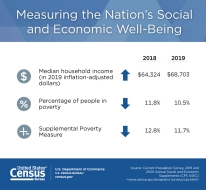
SEPT. 15, 2020 — The U.S. Census Bureau announced today that median household income in 2019 increased 6.8% from 2018, and the official poverty charge per unit decreased 1.3 percentage points. Meanwhile the percentage of people with health insurance coverage for all or role of 2019 was 92.0% and eight.0% of people, or 26.1 meg, did not take health insurance at any point during 2019, co-ordinate to the 2020 Current Population Survey Annual Social and Economic Supplement (CPS ASEC).
Median household income was $68,703 in 2019, an increase of 6.8% from the 2018 median. Between 2018 and 2019, the real median earnings of all workers increased by 1.iv%, while the real median earnings of full-time, twelvemonth-circular workers increased 0.8%. The 2019 real median earnings of men and women who worked full-fourth dimension, yr-round increased by ii.one% and three.0%, respectively, between 2018 and 2019. The difference between the 2018-2019 per centum changes in median earnings for men and women working full-time, yr-round was not statistically significant. The number of full-time, year-round workers increased past approximately ane.two million between 2018 and 2019. Betwixt 2018 and 2019, the full number of people with earnings increased by nigh 2.2 million.
The official poverty rate in 2019 was 10.5%, a decrease of 1.three percentage points from eleven.viii% in 2018. This is the fifth consecutive almanac turn down in the national poverty rate. Since 2014, the poverty charge per unit has fallen 4.3 percentage points, from 14.8% to 10.five%. The 2019 poverty rate of 10.5% is the lowest charge per unit observed since estimates were initially published for 1959. The number of people in poverty in 2019 was 34.0 million, iv.2 million fewer people than 2018.
Private health insurance coverage was more prevalent than public coverage, covering 68.0% and 34.1% of the population at some point during the year, respectively. Employment-based insurance was the most common subtype. Some people may accept more than one coverage type during the calendar year.
These findings are independent in two reports: Income and Poverty in the United States: 2019 and Health Insurance Coverage in the United States: 2019.
Some other Census Agency written report, The Supplemental Poverty Measure: 2019, was also released today. The Supplemental Poverty Measure (SPM) charge per unit in 2019 was 11.7%. This was 1.0 percent point lower than the 2018 SPM rate of 12.viii%. The SPM provides an alternative style of measuring poverty in the United States and serves as an boosted indicator of economical well-being. The Demography Agency has published poverty estimates using the SPM annually since 2011 with the collaboration of the U.South. Bureau of Labor Statistics (BLS).
The Current Population Survey (CPS), sponsored jointly by the Demography Bureau and BLS, is conducted every month and is the master source of labor strength statistics for the U.S. population; information technology is used to calculate monthly unemployment rate estimates. Supplements are added in most months; the CPS ASEC is designed to requite almanac, national estimates of income, poverty and health insurance numbers and rates. The CPS ASEC is conducted in Feb, March and April. It collects information about income and wellness insurance coverage during the prior agenda year. As data were collected in February, March and April 2020 almost income and health insurance coverage in 2019, this report does not reflect economic impacts related to COVID-19, but instead serves as a pre-pandemic benchmark for futurity research.
This year, data collection faced extraordinary circumstances. Every bit the United States began to grapple with the implications of the COVID-19 pandemic for the nation, interviewing for the March CPS began on March 15. In order to protect the health and safety of Census Bureau staff and respondents, the survey suspended in-person interviewing and closed both Figurer-Assisted Telephone Interviewing (CATI) contact centers on March twenty. For the balance of March and through April, the Census Bureau connected to attempt all interviews by phone. For those whose first month in the survey was March or April, the Census Bureau used vendor-provided telephone numbers associated with the sample accost.
While the Census Bureau went to great lengths to complete interviews past phone, the response rate for the CPS basic household survey was 73% in March 2020, virtually ten percentage points lower than in preceding months and the aforementioned menstruation in 2019, which were regularly above 80%. The alter from conducting showtime interviews in person to making start contacts by telephone contributed to the lower response rates and it is probable that the characteristics of people for whom a phone number was establish may be systematically different from the people for whom the Census Agency was unable to obtain a telephone number. While the Census Bureau creates weights designed to suit for nonresponse and to control weighted counts to independent population estimates past age, sex, race and Hispanic origin, the magnitude of the increment in (and differential nature of) nonresponse related to the pandemic likely reduced their efficacy. Using administrative information, Census Bureau researchers have documented that the nonrespondents in 2020 are less like to respondents than in earlier years. Of particular interest for the estimates in this study released today are the differences in median income and educational attainment, indicating that respondents in 2020 had relatively higher income and were more educated than nonrespondents.
The 2019 income and poverty report is based on the CPS ASEC and includes comparisons with the previous year and historical tables in the report, which contain statistics dorsum to 1959. The health insurance report is based on both the CPS ASEC and the American Community Survey (ACS). Land and local income, poverty and wellness insurance estimates from the ACS will exist released Thursday, Sept. 17.
Income
Median household income was $68,703 in 2019, an increase of six.eight% from the 2018 median of $64,324.
The 2019 real median income of family households and nonfamily households increased 7.3% and 6.ii%, respectively, between 2018 and 2019. This is the fifth sequent annual increment in median household income for family households and the second consecutive increase for nonfamily households. The divergence between the 2018-2019 per centum changes in median income for family (seven.3%) and nonfamily (6.2%) households was not statistically significant.
Real median household incomes increased for all regions in 2019: 6.8% in the Northeast, iv.viii% in the Midwest, 6.1% in the S, and seven.0% in the Due west. The differences between the 2018-2019 percent changes in median household income for all regions were non statistically meaning.
Race and Hispanic Origin
(Race data refer to people reporting a unmarried race simply; Hispanics can be of any race.)
- The 2019 real median incomes of White, Blackness, Asian and Hispanic households all increased from 2018. The differences between the 2018-2019 percent changes in household median income for each race group were non statistically pregnant.
Earnings
- The 2019 real median earnings of men ($57,456) and women ($47,299) who worked full-fourth dimension, twelvemonth-round increased by 2.1% and iii.0%, respectively. The divergence between the 2018-2019 percent alter in median earnings for men working total-time, year-circular and women working total-time, year-circular was not statistically significant.
- The 2019 female-to-male person earnings ratio was 0.823, not statistically unlike from the 2018 ratio.
- Between 2018 and 2019, the real median earnings of all workers and total-time, year-round workers increased i.4% and 0.viii%, respectively.
- Between 2018 and 2019, the total number of people with earnings, regardless of work experience, increased past nearly 2.ii 1000000. The number of full-time, year-round workers increased by approximately i.2 million.
Poverty
As defined past the Office of Management and Upkeep (OMB) and updated for inflation using the Consumer Price Index, the weighted average poverty threshold for a family of four in 2019 was $26,172. (See <world wide web.demography.gov/data/tables/fourth dimension-serial/demo/income-poverty/historical-poverty-thresholds.html> for the complete ready of dollar value thresholds that vary by family unit size and composition.)
- The official poverty rate in 2019 was 10.5%; downward 1.3 percentage points from 11.viii% in 2018 (the OMB adamant the official definition of poverty in Statistical Policy Directive fourteen).
- The 2019 poverty rate of 10.5% marks the fifth consecutive annual decline in poverty. Since 2014, the poverty charge per unit has fallen 4.three percent points, from fourteen.eight% to ten.5%.
- The 2019 poverty rate of ten.5% is the lowest rate observed since estimates were initially published for 1959.
- In 2019, there were 34.0 million people in poverty, approximately 4.2 meg fewer people than 2018.
Race and Hispanic Origin
(Race data refer to people reporting a single race only; Hispanics tin be of any race.)
- Between 2018 and 2019, poverty rates declined for all major race and Hispanic origin groups.
- The poverty rate for Whites decreased one.0 percentage point to 9.1%. The poverty rate for Blacks decreased by 2.0 percentage points to 18.eight%. The poverty charge per unit for Asians decreased 2.8 percentage points to 7.3%. The poverty rate for Hispanics decreased by 1.8 per centum points to fifteen.7%.
- The per centum point change in poverty rates from 2018 to 2019 for Blacks is non significantly different than the percent point change for Whites, Asians or Hispanics. The percentage bespeak alter from 2018 to 2019 for Hispanics is not significantly dissimilar from the per centum point change for Asians.
Age
- Between 2018 and 2019, poverty rates for children under the age of eighteen decreased 1.8 percentage points, from 16.2% to 14.iv%.
- Poverty rates decreased 1.ii percentage points for adults ages xviii to 64, from ten.vii% to ix.4%.
- The poverty charge per unit for people age 65 and older decreased past 0.ix percentage points, from ix.7% to 8.9%.
Supplemental Poverty Measure
The SPM extends the official poverty mensurate by taking into business relationship many of the government programs designed to assist low-income families and individuals that are non included in the current official poverty mensurate.
- The SPM released today shows: in 2019, the overall SPM rate was 11.7%. This was 1.0 per centum betoken lower than the 2018 SPM rate of 12.8%.
- The SPM charge per unit for 2019 was 1.3 per centum points higher than the official poverty rate of ten.5%.
- At that place were xvi states plus the Commune of Columbia for which SPM rates were higher than official poverty rates, 25 states with lower rates, and ix states for which the differences were not statistically significant.
- Social Security continued to exist the about of import anti-poverty program, moving 26.5 one thousand thousand individuals out of poverty in 2019. Refundable taxation credits moved seven.five million people out of poverty.
Age
- SPM rates were downwardly for all major age categories: children under historic period eighteen, adults ages 18 to 64, and adults age 65 and older betwixt 2018 and 2019.
While the official poverty mensurate includes simply pretax money income, the SPM adds the value of in-kind benefits, such as the Supplemental Nutrition Help Program, schoolhouse lunches, housing aid and refundable tax credits.
Additionally, the SPM deducts necessary expenses for disquisitional goods and services from income. Expenses that are deducted include taxes, child intendance, commuting expenses, contributions toward the cost of medical care and health insurance premiums, and child support paid to another household. The SPM permits the examination of the effects of government transfers on poverty estimates. For example, non including refundable tax credits (the Earned Income Tax Credit and the refundable portion of the child tax credit) in resources, the poverty rate for all people would accept been 14.0% rather than xi.7%. The SPM does not supercede the official poverty measure and is not used to determine eligibility for government programs.
Health Insurance
As in the by several years, the Census Agency is releasing estimates of health insurance from two surveys. The Electric current Population Survey Annual Social and Economic Supplement (CPS ASEC) asks people about coverage during the entire previous calendar year. The American Community Survey (ACS) asks people to study their health insurance coverage at the fourth dimension of interview. The apply of both surveys provides a more than complete moving picture of health insurance coverage in the United States in 2019. Highlights reporting coverage in 2019 come up from the CPS ASEC. Highlights reporting change in health coverage from 2018 to 2019 or health coverage at the state-level come up from the ACS.
- In 2019, 8.0% of people, or 26.1 million, did not accept health insurance at any point during the twelvemonth, co-ordinate to the CPS ASEC.
- The percentage of people with wellness insurance coverage for all or part of 2019 was 92.0%.
- In 2019, ix.2% of people, or 29.6 meg, were not covered by health insurance at the time of interview, according to the ACS, upwardly from 8.ix% and 28.half-dozen meg in 2018.
- In 2019, the pct of people with employer-provided coverage at the time of interview was slightly college than in 2018, from 55.2% in 2018 to 55.4% in 2019.
- The percentage of people with Medicaid coverage at the time of interview decreased to 19.8% in 2019, downwardly from 20.v% in 2018.
- Between 2018 and 2019, the percentage of people without health insurance coverage decreased in one state and increased in 19 states.
- All states and the Commune of Columbia had a lower uninsured rate in 2019 than in 2010.
Regional trends are available for income, poverty, SPM and health insurance in each respective written report, too equally tables showing state-level coverage for health insurance and poverty rates using the supplemental poverty measure.
State and Local Estimates From the American Community Survey
Some country-level health insurance data from the ACS are included in this release. On Th, Sept. 17, the Census Agency volition release 2019 single-year estimates of median household income, poverty and health insurance for all states, counties, places and other geographic units with populations of 65,000 or more from the ACS. These statistics will include numerous social, economic and housing characteristics, such every bit language, education, commuting, employment, mortgage condition and rent. Subscribers will exist able to access these estimates on an embargoed basis.
The ACS provides a wide range of important statistics well-nigh people and housing for every community (i.e., census tracts or neighborhoods) across the nation. The results are used by anybody from town and city planners to retailers and homebuilders. The survey is the only source of local estimates for almost of the 40 topics it covers.
The CPS ASEC and ACS are subject field to sampling and nonsampling errors. All comparisons fabricated here and in each corresponding report accept been tested and plant to exist statistically pregnant at the 90% conviction level, unless otherwise noted.
For additional information on the source of the information and accuracy of the income, poverty and health insurance estimates, visit <https://www2.census.gov/programs-surveys/cps/techdocs/cpsmar20.pdf>
###
Source: https://www.census.gov/newsroom/press-releases/2020/income-poverty.html

Post a Comment for "In 2014, the Poverty Line Was About ________ for a Family of Four."