what quantity of energy does it take to convert 0.500kg
Learning Objectives
By the stop of this department, yous will be able to:
- Observe oestrus transfer and change in temperature and mass.
- Calculate final temperature after rut transfer between two objects.
One of the major effects of oestrus transfer is temperature change: heating increases the temperature while cooling decreases it. We presume that in that location is no phase change and that no piece of work is done on or by the system. Experiments show that the transferred heat depends on three factors—the change in temperature, the mass of the organisation, and the substance and stage of the substance.
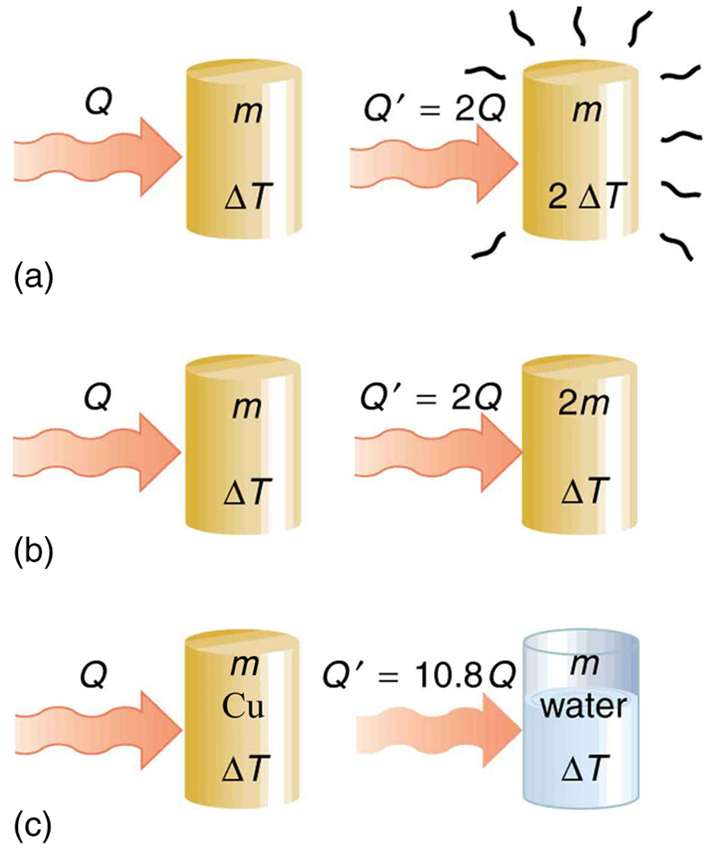
Figure 1. The heat Q transferred to cause a temperature change depends on the magnitude of the temperature alter, the mass of the organisation, and the substance and stage involved. (a) The corporeality of heat transferred is direct proportional to the temperature modify. To double the temperature modify of a mass m, you need to add together twice the rut. (b) The corporeality of heat transferred is besides directly proportional to the mass. To cause an equivalent temperature alter in a doubled mass, you lot demand to add together twice the oestrus. (c) The amount of oestrus transferred depends on the substance and its phase. If it takes an amount Q of estrus to crusade a temperature change ΔT in a given mass of copper, it volition take ten.8 times that amount of rut to crusade the equivalent temperature modify in the same mass of water bold no phase change in either substance.
The dependence on temperature change and mass are easily understood. Owing to the fact that the (average) kinetic free energy of an atom or molecule is proportional to the absolute temperature, the internal energy of a system is proportional to the absolute temperature and the number of atoms or molecules. Owing to the fact that the transferred rut is equal to the change in the internal energy, the heat is proportional to the mass of the substance and the temperature change. The transferred rut besides depends on the substance and so that, for case, the rut necessary to raise the temperature is less for alcohol than for water. For the aforementioned substance, the transferred estrus as well depends on the phase (gas, liquid, or solid).
Oestrus Transfer and Temperature Change
The quantitative relationship between heat transfer and temperature alter contains all 3 factors:Q =mcΔT, where Q is the symbol for heat transfer, g is the mass of the substance, and ΔT is the change in temperature. The symbol c stands for specific heat and depends on the textile and phase. The specific rut is the amount of heat necessary to change the temperature of one.00 kg of mass by i.00ºC. The specific rut c is a belongings of the substance; its SI unit is J/(kg ⋅ K) or J/(kg ⋅ ºC). Retrieve that the temperature change (ΔT) is the same in units of kelvin and degrees Celsius. If heat transfer is measured in kilocalories, then the unit of specific heat is kcal/(kg ⋅ ºC).
Values of specific oestrus must more often than not be looked up in tables, considering there is no unproblematic manner to calculate them. In general, the specific estrus also depends on the temperature. Tabular array 1 lists representative values of specific oestrus for various substances. Except for gases, the temperature and volume dependence of the specific heat of most substances is weak. We see from this table that the specific heat of water is 5 times that of glass and x times that of iron, which means that it takes 5 times as much oestrus to enhance the temperature of water the same amount equally for drinking glass and ten times as much heat to raise the temperature of water as for iron. In fact, water has one of the largest specific heats of any material, which is important for sustaining life on Earth.
Case ane. Calculating the Required Heat: Heating Water in an Aluminum Pan
A 0.500 kg aluminum pan on a stove is used to estrus 0.250 liters of water from 20.0ºC to 80.0ºC. (a) How much rut is required? What per centum of the heat is used to raise the temperature of (b) the pan and (c) the water?
Strategy
The pan and the h2o are always at the same temperature. When you lot put the pan on the stove, the temperature of the water and the pan is increased past the same amount. We use the equation for the heat transfer for the given temperature change and mass of water and aluminum. The specific heat values for h2o and aluminum are given in Table 1.
Solution
Considering water is in thermal contact with the aluminum, the pan and the water are at the same temperature.
Calculate the temperature deviation:
ΔT = T f − T i = 60.0ºC.
Calculate the mass of h2o. Because the density of water is thou kg/mthree, one liter of h2o has a mass of 1 kg, and the mass of 0.250 liters of water is m w = 0.250 kg.
Calculate the heat transferred to the water. Use the specific heat of water in Tabular array 1:
Q westward =g west c wΔT = (0.250 kg)(4186 J/kgºC)(60.0ºC) = 62.8 kJ.
Calculate the heat transferred to the aluminum. Utilise the specific oestrus for aluminum in Tabular array 1:
Q Al =m Al c AlΔT= (0.500 kg)(900 J/kgºC)(60.0ºC) = 27.0 × 10iv J = 27.0 kJ.<
Compare the percent of rut going into the pan versus that going into the water. First, observe the total transferred heat:
Q Total =Q w + Q Al= 62.8 kJ + 27.0 kJ = 89.8 kJ.
Thus, the amount of rut going into heating the pan is
[latex]\frac{27.0\text{ kJ}}{89.eight\text{ kJ}}\times100\%=30.1\%\\[/latex]
and the corporeality going into heating the water is
[latex]\frac{62.eight\text{ kJ}}{89.8\text{ kJ}}\times100\%=69.9\%\\[/latex].
Discussion
In this example, the rut transferred to the container is a significant fraction of the total transferred heat. Although the mass of the pan is twice that of the water, the specific heat of water is over four times greater than that of aluminum. Therefore, information technology takes a bit more than than twice the heat to achieve the given temperature change for the water as compared to the aluminum pan.
Example 2. Computing the Temperature Increment from the Work Done on a Substance: Truck Brakes Overheat on Downhill Runs
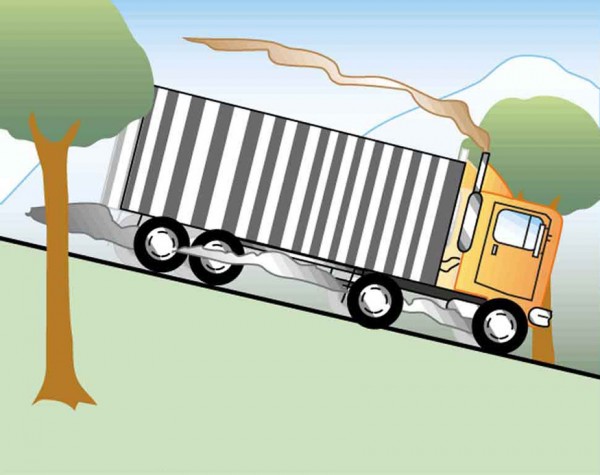
Figure ii. The smoking brakes on this truck are a visible evidence of the mechanical equivalent of heat.
Truck brakes used to control speed on a downhill run practise work, converting gravitational potential energy into increased internal energy (higher temperature) of the brake material. This conversion prevents the gravitational potential free energy from beingness converted into kinetic energy of the truck. The trouble is that the mass of the truck is large compared with that of the brake cloth absorbing the energy, and the temperature increase may occur also fast for sufficient heat to transfer from the brakes to the environs.
Calculate the temperature increase of 100 kg of brake material with an average specific rut of 800 J/kg ⋅ ºC if the material retains ten% of the free energy from a 10,000-kg truck descending 75.0 m (in vertical displacement) at a constant speed.
Strategy
If the brakes are non applied, gravitational potential free energy is converted into kinetic energy. When brakes are applied, gravitational potential energy is converted into internal energy of the restriction material. Nosotros first summate the gravitational potential free energy (Mgh) that the entire truck loses in its descent and and then observe the temperature increase produced in the brake material alone.
Solution
- Summate the modify in gravitational potential energy as the truck goes downhillMgh = (10,000 kg)(9.eighty m/s2)(75.0 m) = 7.35 × 10⁶ J.
- Calculate the temperature from the heat transferred using Q =Mgh and [latex]\Delta{T}=\frac{Q}{mc}\\[/latex], where m is the mass of the brake textile. Insert the values g= 100 kg and c= 800 J/kg ⋅ ºC to find [latex]\Delta{T}=\frac{\left(7.35\times10^6\text{ J}\right)}{\left(100\text{ kg}\right)\left(800\text{ J/kg}^{\circ}\text{C}\right)}=92^{\circ}C\\[/latex].
Discussion
This temperature is close to the boiling signal of h2o. If the truck had been traveling for some time, then just before the descent, the brake temperature would likely be higher than the ambient temperature. The temperature increase in the descent would probable enhance the temperature of the brake material above the boiling point of water, and so this technique is not practical. Nonetheless, the same idea underlies the recent hybrid technology of cars, where mechanical energy (gravitational potential energy) is converted by the brakes into electrical energy (battery).
| Table i. Specific Heats[1] of Various Substances | ||
|---|---|---|
| Substances | Specific heat (c) | |
| Solids | J/kg ⋅ ºC | kcal/kg ⋅ ºC[2] |
| Aluminum | 900 | 0.215 |
| Asbestos | 800 | 0.nineteen |
| Concrete, granite (boilerplate) | 840 | 0.20 |
| Copper | 387 | 0.0924 |
| Glass | 840 | 0.20 |
| Aureate | 129 | 0.0308 |
| Human body (average at 37 °C) | 3500 | 0.83 |
| Water ice (average, −50°C to 0°C) | 2090 | 0.fifty |
| Iron, steel | 452 | 0.108 |
| Lead | 128 | 0.0305 |
| Silvery | 235 | 0.0562 |
| Wood | 1700 | 0.iv |
| Liquids | ||
| Benzene | 1740 | 0.415 |
| Ethanol | 2450 | 0.586 |
| Glycerin | 2410 | 0.576 |
| Mercury | 139 | 0.0333 |
| Water (15.0 °C) | 4186 | 1.000 |
| Gases [3] | ||
| Air (dry out) | 721 (1015) | 0.172 (0.242) |
| Ammonia | 1670 (2190) | 0.399 (0.523) |
| Carbon dioxide | 638 (833) | 0.152 (0.199) |
| Nitrogen | 739 (1040) | 0.177 (0.248) |
| Oxygen | 651 (913) | 0.156 (0.218) |
| Steam (100°C) | 1520 (2020) | 0.363 (0.482) |
Note that Case two is an analogy of the mechanical equivalent of estrus. Alternatively, the temperature increase could exist produced by a blow torch instead of mechanically.
Example 3. Calculating the Final Temperature When Oestrus Is Transferred Betwixt Two Bodies: Pouring Cold Water in a Hot Pan
Suppose y'all cascade 0.250 kg of xx.0ºC water (about a loving cup) into a 0.500-kg aluminum pan off the stove with a temperature of 150ºC. Assume that the pan is placed on an insulated pad and that a negligible corporeality of h2o boils off. What is the temperature when the h2o and pan attain thermal equilibrium a short time later?
Strategy
The pan is placed on an insulated pad so that little heat transfer occurs with the surroundings. Originally the pan and h2o are not in thermal equilibrium: the pan is at a higher temperature than the water. Oestrus transfer and then restores thermal equilibrium once the h2o and pan are in contact. Because heat transfer betwixt the pan and water takes place speedily, the mass of evaporated h2o is negligible and the magnitude of the rut lost by the pan is equal to the heat gained by the water. The commutation of heat stops in one case a thermal equilibrium between the pan and the water is achieved. The heat commutation can be written as |Q hot|=Q cold.
Solution
Use the equation for estrus transfer Q =mcΔT to limited the heat lost by the aluminum pan in terms of the mass of the pan, the specific estrus of aluminum, the initial temperature of the pan, and the concluding temperature:Q hot =yard Al c Al(T f − 150ºC).
Express the oestrus gained by the h2o in terms of the mass of the water, the specific heat of water, the initial temperature of the water and the final temperature:Q cold=m Westward c W(T f − 20.0ºC).
Note that Q hot<0 and Q common cold>0 and that they must sum to zilch because the heat lost by the hot pan must be the aforementioned every bit the heat gained by the cold water:
[latex]\begin{array}{lll}Q_{\text{cold}}+Q_{\text{hot}}&=&0\\Q_{\text{common cold}}&=&-Q_{\text{hot}}\\m_{\text{W}}c_{\text{W}}\left(T_{\text{f}}-twenty.0^{\circ}\text{C}\right)&=&-m_{\text{Al}}c_{\text{Al}}\left(T_{\text{f}}-150^{\circ}\text{C}\correct)\end{array}\\[/latex]
This an equation for the unknown last temperature, T f.
Bring all terms involving T f on the left paw side and all other terms on the right hand side. Solve for T f,
[latex]\displaystyle{T_{\text{f}}}=\frac{m_{\text{Al}}c_{\text{Al}}\left(T_{\text{f}}-150^{\circ}\text{C}\right)+m_{\text{W}}c_{\text{Due west}}\left(T_{\text{f}}-20.0^{\circ}\text{C}\right)}{m_{\text{Al}}c_{\text{Al}}+m_{\text{W}}c_{\text{W}}}\\[/latex],
and insert the numerical values:
[latex]\begin{array}{lll}T_{\text{f}}&=&\frac{\left(0.500\text{ kg}\correct)\left(900\text{ J/kg}^{\circ}\text{C}\correct)\left(150^{\circ}\text{C}\right)+\left(0.250\text{ kg}\right)\left(4186\text{ J/kg}^{\circ}\text{C}\right)\left(xx.0^{\circ}\text{C}\right)}{\left(0.500\text{ kg}\right)\left(900\text{ J/kg}^{\circ}\text{C}\right)+\left(0.250\text{ kg}\right)\left(4186\text{ J/kg}^{\circ}\text{C}\right)}\\\text{ }&=&\frac{88430\text{ J}}{1496.5\text{ J}/^{\circ}\text{C}}\\\text{ }&=&59.1^{\circ}\text{C}\cease{array}\\[/latex]
Discussion
This is a typical calorimetry trouble—2 bodies at different temperatures are brought in contact with each other and substitution heat until a common temperature is reached. Why is the last temperature so much closer to xx.0ºC than 150ºC? The reason is that water has a greater specific oestrus than most mutual substances and thus undergoes a minor temperature change for a given rut transfer. A large torso of water, such every bit a lake, requires a large amount of oestrus to increase its temperature appreciably. This explains why the temperature of a lake stays relatively constant during a twenty-four hours fifty-fifty when the temperature change of the air is large. Withal, the water temperature does alter over longer times (due east.chiliad., summer to winter).
Accept-Dwelling house Experiment: Temperature Change of State and Water
What heats faster, land or water?
To study differences in estrus chapters:
- Place equal masses of dry sand (or soil) and h2o at the same temperature into ii pocket-sized jars. (The boilerplate density of soil or sand is most ane.6 times that of h2o, so y'all can achieve approximately equal masses by using 50% more than water by volume.)
- Oestrus both (using an oven or a estrus lamp) for the same amount of time.
- Record the final temperature of the two masses.
- Now bring both jars to the same temperature by heating for a longer period of time.
- Remove the jars from the heat source and measure their temperature every 5 minutes for nearly 30 minutes.
Which sample cools off the fastest? This action replicates the phenomena responsible for land breezes and bounding main breezes.
Check Your Understanding
If 25 kJ is necessary to raise the temperature of a block from 25ºC to 30ºC, how much heat is necessary to estrus the cake from 45ºC to 50ºC?
Solution
The heat transfer depends only on the temperature departure. Since the temperature differences are the aforementioned in both cases, the same 25 kJ is necessary in the 2d case.
Section Summary
- The transfer of heat Q that leads to a alter ΔT in the temperature of a body with mass m is Q =mcΔT, where c is the specific oestrus of the material. This relationship can too be considered as the definition of specific heat.
Conceptual Questions
- What three factors touch on the oestrus transfer that is necessary to change an object'due south temperature?
- The brakes in a car increase in temperature by ΔT when bringing the automobile to rest from a speed v. How much greater would ΔT exist if the car initially had twice the speed? You may assume the car to end sufficiently fast so that no heat transfers out of the brakes.
Bug & Exercises
- On a hot day, the temperature of an 80,000-L pond puddle increases past 1.50ºC. What is the net estrus transfer during this heating? Ignore any complications, such as loss of water by evaporation.
- Show that 1 cal/one thousand · ºC =1 kcal/kg · ºC.
- To sterilize a 50.0-g drinking glass baby canteen, nosotros must raise its temperature from 22.0ºC to 95.0ºC. How much estrus transfer is required?
- The aforementioned heat transfer into identical masses of dissimilar substances produces different temperature changes. Calculate the final temperature when 1.00 kcal of heat transfers into 1.00 kg of the following, originally at 20.0ºC: (a) water; (b) concrete; (c) steel; and (d) mercury.
- Rubbing your hands together warms them by converting piece of work into thermal energy. If a woman rubs her easily dorsum and forth for a total of 20 rubs, at a altitude of 7.50 cm per rub, and with an boilerplate frictional forcefulness of 40.0 N, what is the temperature increase? The mass of tissues warmed is but 0.100 kg, by and large in the palms and fingers.
- A 0.250-kg block of a pure material is heated from xx.0ºC to 65.0ºC by the addition of four.35 kJ of energy. Calculate its specific oestrus and identify the substance of which it is most likely composed.
- Suppose identical amounts of heat transfer into different masses of copper and h2o, causing identical changes in temperature. What is the ratio of the mass of copper to water?
- (a) The number of kilocalories in food is determined by calorimetry techniques in which the food is burned and the amount of heat transfer is measured. How many kilocalories per gram are there in a v.00-one thousand peanut if the energy from burning it is transferred to 0.500 kg of h2o held in a 0.100-kg aluminum loving cup, causing a 54.9ºC temperature increase? (b) Compare your answer to labeling information plant on a parcel of peanuts and comment on whether the values are consistent.
- Following vigorous exercise, the body temperature of an lxxx.0-kg person is forty.0ºC. At what rate in watts must the person transfer thermal energy to reduce the the trunk temperature to 37.0ºC in 30.0 min, assuming the trunk continues to produce free energy at the rate of 150 West? 1 watt = 1 joule/second or i W = 1 J/s.
- Even when shut down after a flow of normal employ, a large commercial nuclear reactor transfers thermal free energy at the rate of 150 MW by the radioactive disuse of fission products. This estrus transfer causes a rapid increment in temperature if the cooling system fails (1 watt = 1 joule/2d or 1 Westward = 1 J/s and i MW = one megawatt). (a) Calculate the charge per unit of temperature increase in degrees Celsius per second (ºC/s) if the mass of the reactor core is one.60 × 10v kg and it has an average specific heat of 0.3349 kJ/kg ⋅ ºC. (b) How long would it take to obtain a temperature increment of 2000ºC, which could cause some metals property the radioactive materials to melt? (The initial rate of temperature increase would be greater than that calculated here because the estrus transfer is concentrated in a smaller mass. Later, however, the temperature increment would slow down considering the 5 × 10five-kg steel containment vessel would also brainstorm to rut upward.)
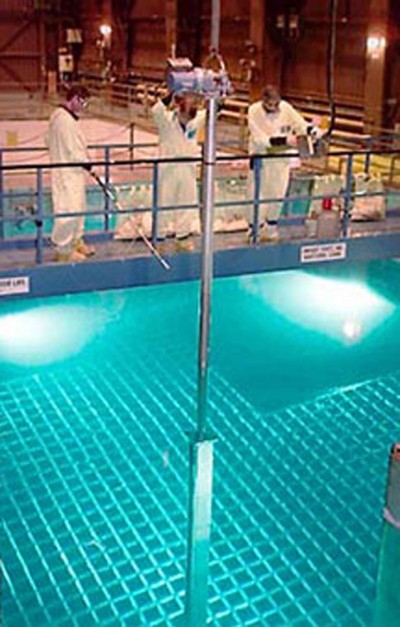
Figure 3. Radioactive spent-fuel pool at a nuclear ability plant. Spent fuel stays hot for a long time. (credit: U.S. Department of Energy)
Glossary
specific estrus: the amount of heat necessary to alter the temperature of 1.00 kg of a substance by 1.00 ºC
Selected Solutions to Issues & Exercises
ane. 5.02 × xeight J
iii. iii.07 × 103 J
five. 0.171ºC
seven. 10.8
nine. 617 W
Source: https://courses.lumenlearning.com/physics/chapter/14-2-temperature-change-and-heat-capacity/

Post a Comment for "what quantity of energy does it take to convert 0.500kg"